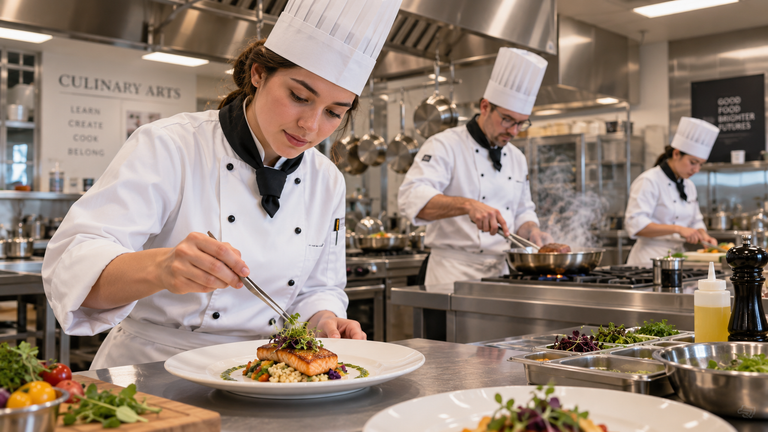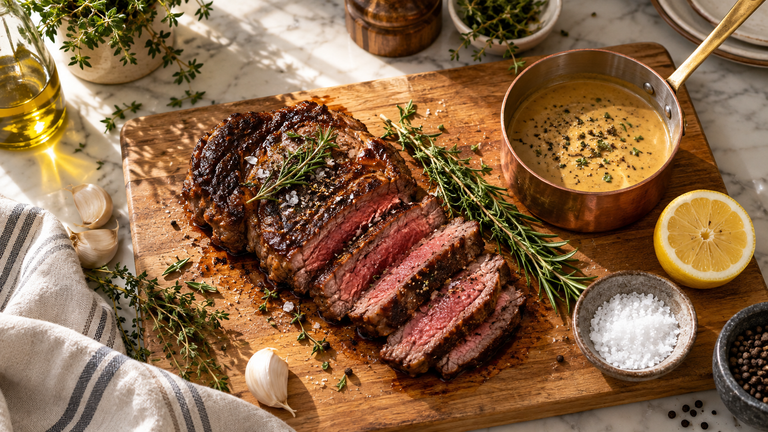
What Do You Learn in Culinary School? Most people picture culinary school as a place where you learn to cook fancy food. In reality, the first few months rarely involve anything close to a finished dish. Before plating a single plate, students spend weeks on knife grips, stock ratios, and why a sauce separates — the unglamorous fundamentals that every working kitchen depends on. If you’re weighing whether culinary school is worth the time and money, understanding exactly what’s taught, in what order, and why, makes that decision much clearer.
This guide breaks down the real curriculum you’ll encounter, from the first knife class to the final capstone project, along with what a typical day looks like and how the skills translate into actual kitchen work.
Why Culinary School Starts With Fundamentals, Not Recipes
A common misconception is that culinary school teaches recipes. It doesn’t, at least not as the primary focus. Recipes are outcomes. What professional kitchens actually need is someone who understands technique well enough to execute any recipe correctly and consistently, under pressure, at volume.
That’s why nearly every accredited program — whether a two-year associate degree or a shorter certificate track — begins with the same foundation: knife skills, sanitation, kitchen safety, and classical technique. Everything else builds on top of that base.
Knife Skills and Kitchen Fundamentals
This is where almost every program starts, and it’s often the most humbling part of the first term.
What’s Covered
- Grip and control — how to hold a chef’s knife properly for both power and precision
- Standard cuts — julienne, brunoise, chiffonade, batonnet, and dice sizes (small, medium, large)
- Knife maintenance — honing versus sharpening, and how to keep an edge throughout a shift
- Speed and consistency — cutting uniform pieces quickly enough to keep pace in a working kitchen
Why It Matters
Uniform cuts aren’t about presentation alone. Vegetables cut to the same size cook at the same rate, which is the difference between a stir-fry with evenly cooked pieces and one with raw centers next to mush. Instructors will often have students repeat the same cut for an entire class period — not because it’s interesting, but because muscle memory is what eventually lets a cook move fast without sacrificing accuracy.
Food Safety and Sanitation
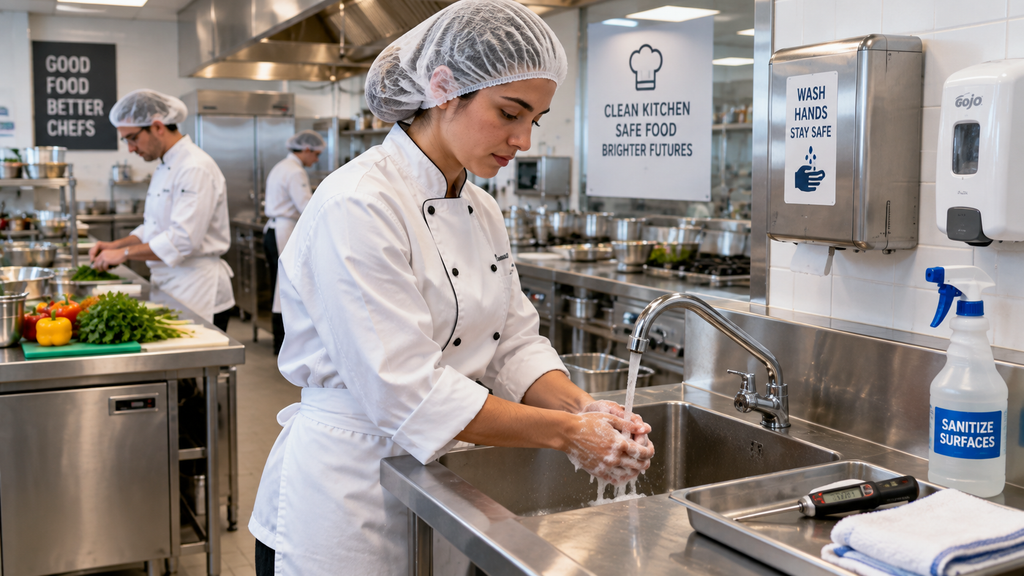
Long before students touch a stove, most programs require a food safety certification, commonly a ServSafe or equivalent credential depending on the country and state.
Core Topics
- Proper food storage temperatures and the “danger zone” for bacterial growth
- Cross-contamination prevention between raw and ready-to-eat foods
- Personal hygiene standards required in professional kitchens
- Allergen awareness and how to handle special dietary requests safely
This section isn’t treated as an afterthought. Health code violations can shut down a restaurant, and most culinary programs will not let a student advance to hands-on cooking labs without passing a sanitation exam first.
Classical Cooking Techniques
Once fundamentals are in place, programs typically move into classical technique, often rooted in French culinary tradition because it forms the technical vocabulary used across most professional kitchens today, regardless of cuisine.
What Students Learn
- The five mother sauces — béchamel, velouté, espagnole, hollandaise, and tomato sauce, along with their common derivatives
- Stock making — the difference between white and brown stock, and why proper ratios and skimming technique affect clarity and flavor
- Cooking methods — sautéing, braising, roasting, poaching, and deep-frying, along with when each method is the right choice for a given ingredient
- Mise en place — the practice of fully preparing and organizing ingredients before cooking begins, which is less about efficiency alone and more about consistency under pressure
Why Classical Technique Still Matters
Even chefs who go on to cook contemporary or fusion cuisine rely on this foundation. A well-made pan sauce still depends on the same reduction and emulsification principles as a classical French sauce. Understanding the “why” behind a mother sauce means a cook can improvise a sauce for an unfamiliar dish rather than needing an exact recipe every time.
Baking and Pastry Fundamentals
Most culinary programs include at least one dedicated baking and pastry course, even for students focused on savory cooking, because the underlying science is different enough to require separate instruction.
Topics Typically Covered
- Basic bread doughs and the role of gluten development in texture
- Laminated doughs such as croissant and puff pastry
- Cake methods, including creaming, foaming, and one-bowl techniques
- Custards, curds, and basic pastry cream
- Precision measuring, since baking relies on exact ratios in a way savory cooking often doesn’t
Students who plan to specialize later in pastry will usually take additional advanced coursework, but this introductory unit ensures every graduate understands baking science at a functional level.
Menu Planning, Costing, and Kitchen Management
Cooking well is only part of working in a professional kitchen. Programs also cover the business side of food service, which surprises some students who expected a purely hands-on curriculum.
Key Areas
- Food costing — calculating the cost per plate and setting menu prices that maintain profitability
- Portion control — standardizing serving sizes to control both cost and consistency
- Inventory management — ordering, rotation (FIFO — first in, first out), and minimizing waste
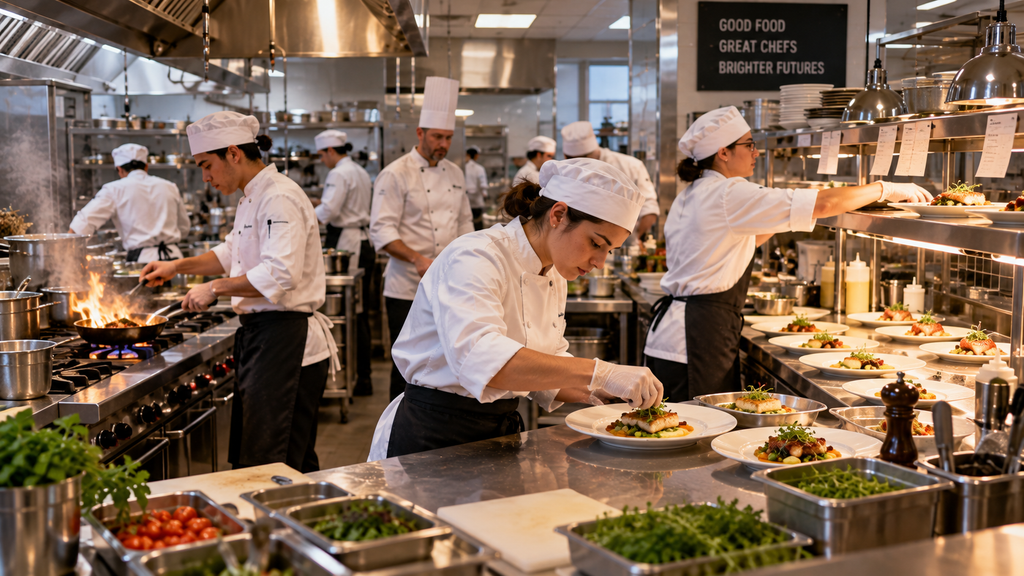
- Kitchen organization — understanding the brigade system and how different stations (garde manger, sauté, pastry, grill) function together during service
This section matters even for students who plan to work as line cooks rather than managers, because understanding cost and waste helps any cook work more efficiently within a kitchen’s operational reality.
Global Cuisines and Flavor Development
Later in most programs, coursework expands into regional and international cuisines, building on the technical foundation established earlier.
What This Typically Includes
- Signature techniques and ingredients from cuisines such as Italian, Mexican, Southeast Asian, and Middle Eastern cooking
- Spice and flavor pairing principles, rather than memorized recipes alone
- How climate, culture, and available ingredients shaped different culinary traditions
- Building flavor in layers — for example, how a base of aromatics, a cooking fat, and a finishing acid work together across very different cuisines
This portion of the curriculum is often where students discover a specific culinary direction they want to pursue after graduation.
Hands-On Kitchen Labs and Real Service Experience
Lecture-based learning only goes so far in a field this physical. Most programs include structured lab time where students cook in teams under simulated or real service conditions.
What This Looks Like
- Timed cooking exercises that mimic the pressure of an actual dinner service
- Rotating through different kitchen stations to build versatility
- Student-run restaurants or dining events open to the public, common in many accredited programs
- Direct feedback from chef-instructors on plating, seasoning, and execution speed
This is typically where students feel the gap between “knowing” a technique and being able to execute it reliably while five other things are happening at once. It’s also the part of the program most graduates describe as the most useful preparation for actual kitchen work.
Externships and Industry Placement
Many culinary programs require or strongly encourage an externship — a working placement in a real restaurant, hotel, or catering operation — usually in the final term.
Why This Matters
Classroom kitchens, no matter how well designed, don’t fully replicate the pace and pressure of a working dinner service. An externship exposes students to:
- Real-time decision-making under time pressure
- Working within an established kitchen hierarchy
- Adapting to a specific chef’s standards and expectations
- Building industry contacts that often lead directly to a first job offer
Programs vary in how they structure this — some place students for a few weeks, others for a full semester — but it’s frequently cited by graduates as the point where culinary theory became practical skill.
What a Typical Week Might Look Like
Programs vary, but a fairly representative week during the technique-heavy portion of a culinary program often includes:
| Day | Focus |
|---|---|
| Monday | Lecture: technique or food science concept |
| Tuesday | Lab: knife skills or technique practice |
| Wednesday | Lab: stock, sauce, or protein cookery |
| Thursday | Lecture: sanitation, costing, or menu planning |
| Friday | Lab: applied cooking exam or plated evaluation |
This rhythm shifts as students progress — later terms lean more heavily into lab time, applied projects, and eventually externship placement.
Is Culinary School Necessary to Become a Chef?
This is one of the most common questions prospective students ask, and it deserves a direct answer: no, it isn’t strictly necessary. Many successful chefs built their careers entirely through kitchen experience, working their way up from entry-level positions. What culinary school offers instead is structure, condensed technical grounding, and industry connections in a shorter timeframe than most people would get from on-the-job learning alone. Whether that trade-off is worth the cost depends heavily on an individual’s learning style, financial situation, and how quickly they want to move into supervisory or specialized roles.
Conclusion
Culinary school is less about learning to cook specific dishes and more about learning a technical language — knife work, classical technique, food science, and kitchen operations — that lets a cook execute almost anything with consistency. The recipes come later, and by the time they do, students already understand exactly why each step works the way it does. For anyone considering this path, the real value isn’t the diploma itself, but the compressed, structured exposure to fundamentals that would otherwise take years to piece together in a working kitchen.
FAQ
How long does culinary school typically take? This varies widely by program type. Certificate programs can run anywhere from six months to a year, while associate degree programs typically take about two years. Bachelor’s degree programs, which include more business and management coursework, usually take four years.
Do you need cooking experience before starting culinary school? No prior professional experience is required for most entry-level programs. Basic comfort in a kitchen helps, but programs are structured to teach fundamentals from the ground up, including students with little to no cooking background.
What’s the difference between a culinary school certificate and a degree? A certificate program focuses primarily on hands-on culinary technique in a shorter timeframe. A degree program covers the same technical foundation but adds coursework in areas like business management, nutrition, and hospitality, which can open doors to supervisory or management roles more quickly.
Will culinary school teach me to specialize in pastry or baking specifically? Most general culinary programs include foundational pastry coursework, but dedicated pastry specialization usually requires a separate program or additional advanced coursework focused specifically on baking and dessert technique.
Is culinary school physically demanding? Yes. Lab and kitchen coursework typically involves long stretches of standing, repetitive knife work, and exposure to heat, and externships often mirror the physical demands of a real restaurant shift. Prospective students with physical limitations should ask specific programs how labs are structured.
Can culinary school graduates work outside of restaurants? Yes. Graduates often go on to work in catering, hotel food service, private chef roles, food styling, recipe development, culinary education, and product development for food companies, in addition to traditional restaurant kitchens.