
Homemade Crispy Falafel
Golden and crunchy on the outside, soft and herby in the middle, Homemade Crispy Falafel is a delicious meat-free meal that is easy to make at home.
These flavorful chickpea patties are packed with fresh parsley, cilantro, garlic, onion, cumin, and coriander. Once fried until deeply golden, the outside becomes wonderfully crisp while the center stays tender and fluffy.
Homemade Crispy Falafel is perfect for stuffing into warm pita bread, adding to a fresh salad, serving with hummus, or enjoying as a snack with creamy tahini sauce.
The recipe uses dried chickpeas soaked overnight instead of canned chickpeas. This small but important step gives the falafel mixture the right texture and helps create those crisp, beautifully browned edges.
There is no complicated technique involved. The chickpeas are soaked, blended with herbs and spices, shaped, and cooked until golden. With a few simple tips, even beginners can make restaurant-style falafel at home.
For an easy Middle Eastern-inspired meal, serve these falafel with [homemade hummus and warm pita bread], [a fresh cucumber tomato salad], or [creamy tahini sauce for dipping].
Ingredients
The ingredient list is simple, but each ingredient plays an important role in creating flavorful, crispy falafel.
For the falafel
- 1 1/2 cups dried chickpeas, about 10 ounces
- 1 small yellow onion, roughly chopped
- 4 garlic cloves, peeled
- 1 cup packed fresh parsley leaves
- 1/2 cup packed fresh cilantro leaves
- 1 teaspoon ground cumin
- 1 teaspoon ground coriander
- 1 teaspoon fine salt
- 1/2 teaspoon black pepper
- 1/2 teaspoon baking soda
- 1/4 teaspoon cayenne pepper, optional
- 1 tablespoon fresh lemon juice
- 2 tablespoons all-purpose flour
- 1 tablespoon sesame seeds, optional
- 1/2 teaspoon ground cardamom, optional
For frying
- 4 to 5 cups neutral cooking oil, such as sunflower, canola, or vegetable oil
Use enough oil to reach about 1 1/2 to 2 inches deep in a heavy-bottomed pan.
For serving
- Warm pita bread
- Tahini sauce
- Hummus
- Sliced cucumber
- Diced tomatoes
- Thinly sliced red onion
- Fresh parsley
- Lemon wedges
- Pickled turnips or pickled vegetables, optional
Ingredient Notes
Dried chickpeas are essential for this recipe.
Do not substitute canned chickpeas directly into the mixture. Canned chickpeas contain much more moisture and can make the falafel soft, fragile, or difficult to shape.
The chickpeas should be soaked in plenty of water until they become plump and tender but still firm enough to hold their shape.
Fresh herbs provide much of the fresh flavor. Parsley gives the falafel a bright green color, while cilantro adds a slightly citrusy, earthy taste.
For a milder flavor, reduce the cilantro and increase the parsley.
Use halal-friendly ingredients throughout, and check packaged products such as flour, spices, sauces, and pita bread for any ingredients that do not fit dietary requirements.
Tools Needed
- Large bowl
- Food processor
- Measuring cups and spoons
- Colander
- Clean kitchen towel
- Small cookie scoop or tablespoon
- Heavy-bottomed skillet or saucepan
- Slotted spoon
- Wire rack
- Baking sheet
- Instant-read thermometer, optional
Step-by-Step Instructions
1. Soak the chickpeas
Place the dried chickpeas in a large bowl.
Cover them with plenty of cold water, leaving several inches of water above the chickpeas because they will expand as they soak.
Cover the bowl and leave the chickpeas at room temperature for 12 to 18 hours.
For the best texture, allow enough time for the chickpeas to become fully hydrated.
2. Drain the chickpeas
Drain the soaked chickpeas thoroughly in a colander.
Rinse them under cold running water, then drain again.
Spread the chickpeas on a clean kitchen towel and gently pat them dry.
They do not need to be completely dry, but excess surface water should be removed.
3. Prepare the vegetables and herbs
Roughly chop the onion and peel the garlic cloves.
Pick the parsley and cilantro leaves from any thick stems.
The herbs do not need to be chopped finely because the food processor will break everything down.
4. Process the chickpeas
Add half of the soaked chickpeas to a food processor.
Pulse several times until they are broken into small, coarse crumbs.
Do not process the chickpeas into a smooth paste.
The mixture should resemble coarse sand or small grains. This texture is important because it helps the falafel stay crisp on the outside and tender in the center.
Transfer the processed chickpeas to a large bowl.
Repeat with the remaining chickpeas.
5. Add the herbs and aromatics
Add the chopped onion, garlic, parsley, and cilantro to the food processor.
Pulse until finely chopped.
Stop and scrape down the sides as needed.
The mixture should look finely minced and evenly green without turning into a wet puree.
6. Combine the mixture
Add the herb mixture to the bowl containing the processed chickpeas.
Add the cumin, coriander, salt, black pepper, baking soda, cayenne pepper if using, lemon juice, flour, sesame seeds, and cardamom if using.
Stir everything together with a sturdy spoon or spatula.
The mixture should hold together when gently pressed between the fingers.
7. Check the texture
Take a small amount of the mixture and squeeze it gently.
It should form a rough ball without becoming sticky or watery.
If the mixture feels too wet, add another tablespoon of flour.
If it feels unusually dry and refuses to hold together, let it rest for a few minutes before making any changes. The chickpeas may continue absorbing moisture.
Avoid adding too much flour because this can make the falafel dense.
8. Rest the mixture
Cover the bowl and refrigerate the falafel mixture for at least 30 minutes.
One hour is even better.
This resting time allows the flavors to blend and makes the mixture easier to shape.
The chilled mixture should feel firm enough to scoop and form.
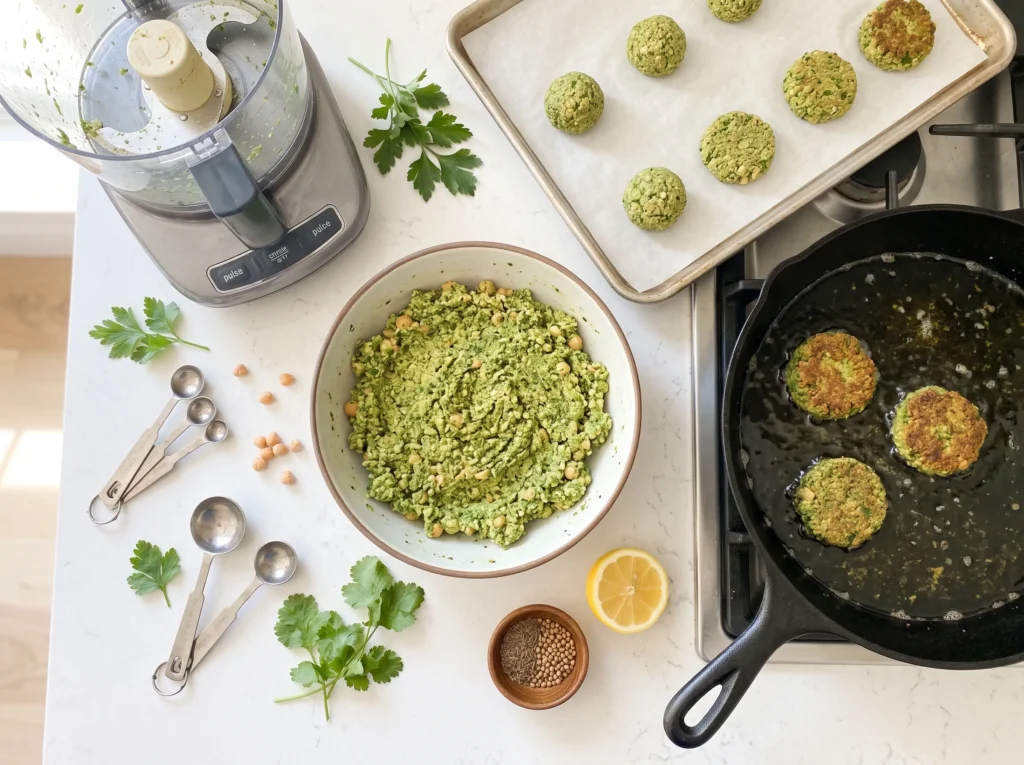
9. Shape the falafel
Use a small cookie scoop or tablespoon to portion the mixture.
Shape each portion into a small ball or slightly flattened patty about 1 1/2 inches wide.
Do not pack the mixture too tightly.
A loose but cohesive shape gives the finished falafel a lighter center.
Place the shaped falafel on a parchment-lined baking sheet while the remaining pieces are prepared.
10. Heat the oil
Pour the cooking oil into a heavy-bottomed skillet or saucepan.
Heat the oil over medium-high heat until it reaches approximately 350°F (175°C).
An instant-read thermometer makes it easier to maintain the correct temperature.
If there is no thermometer, test the oil with a tiny piece of falafel mixture. It should immediately sizzle and rise gently without burning.
11. Fry the falafel
Carefully place several falafel pieces into the hot oil.
Do not overcrowd the pan.
Fry for approximately 3 to 4 minutes per side, turning carefully as needed, until the falafel are deep golden brown and crisp.
The exact cooking time depends on the size of the falafel.
12. Keep the oil temperature steady
After adding the falafel, the oil temperature will naturally drop.
Keep the heat around medium to medium-high and allow the oil to return to temperature between batches.
If the oil is too cool, the falafel can absorb excess oil and become heavy.
If the oil is too hot, the outside may brown before the inside is properly cooked.
13. Drain the falafel
Use a slotted spoon to transfer the cooked falafel to a wire rack placed over a baking sheet.
Allow excess oil to drain away.
A wire rack keeps the bottom crisp better than placing the falafel directly on paper towels.
14. Repeat with the remaining mixture
Continue frying in small batches.
Avoid placing too many pieces into the pan at once.
Keep the cooked falafel in a warm oven set to about 200°F (95°C) if necessary while the remaining batches are cooking.
15. Serve immediately
Serve the falafel while warm and crisp.
Pile them into warm pita bread with lettuce, cucumber, tomato, red onion, and tahini sauce.
They are also excellent served over hummus or alongside a fresh salad.
Add a squeeze of lemon just before eating for a bright finishing touch.
Homemade Crispy Falafel Tips & Variations
The right chickpea texture is the most important part of successful falafel. A few simple techniques can make the difference between crunchy, flavorful falafel and pieces that fall apart.
Always start with dried chickpeas
Dried chickpeas create a much better texture than canned chickpeas for traditional-style falafel.
Soaking allows the chickpeas to soften without becoming fully cooked. They remain firm enough to grind into the coarse mixture needed for crispy falafel.
Canned chickpeas are already cooked and contain more moisture, making the mixture much more difficult to shape and fry.
Do not boil the chickpeas
The chickpeas should only be soaked.
Do not simmer or boil them before processing.
Cooking the chickpeas makes them too soft and can cause the falafel to become mushy or break apart during frying.
Keep the mixture coarse
A common mistake is processing the chickpeas for too long.
The mixture should have tiny visible pieces of chickpea and herbs. It should not look like smooth hummus.
A coarse texture gives the falafel structure and creates more surface area for crisping.
Dry the soaked chickpeas well
Excess water is one of the easiest ways to create a weak falafel mixture.
After draining, pat the chickpeas with a clean kitchen towel.
The goal is not to remove every drop of moisture. The goal is simply to avoid adding unnecessary water to the mixture.
Give the mixture time to rest
At least 30 minutes in the refrigerator helps the mixture firm up.
The resting period also allows the spices, herbs, garlic, and onion to blend together.
For convenient meal preparation, the mixture can be made earlier in the day and refrigerated until cooking time.
Do not make the falafel too large
Small falafel cook more evenly.
If the pieces are too large, the outside can become dark and crispy before the center is fully cooked.
Pieces around 1 1/2 inches wide are a good starting point.
Flatten slightly for extra crispiness
Slightly flattened falafel have more surface area touching the hot oil.
This creates beautifully crisp edges while keeping the middle tender.
Avoid flattening them into thin discs because they can become dry.
Fry in small batches
Overcrowding the pan causes the oil temperature to fall quickly.
This can make the falafel absorb more oil and lose their crisp texture.
Cooking several small batches takes a little longer but produces a much better result.
Keep the oil at the right temperature
Around 350°F (175°C) is a useful target.
If the oil temperature drops significantly, wait briefly before adding another batch.
Consistent oil temperature is one of the secrets to golden, crunchy falafel.
Try an air-fryer version
For a lighter option, shape the falafel into slightly flatter patties and lightly brush or spray them with oil.
Air fry at approximately 375°F (190°C) for 12 to 16 minutes, turning halfway through.
The texture will be somewhat different from deep-fried falafel, but the outside can still become pleasantly crisp.
Bake the falafel
Falafel can also be baked.
Place shaped pieces on a parchment-lined baking sheet, lightly brush them with oil, and bake at 425°F (220°C) for approximately 20 to 25 minutes, turning halfway through.
The edges should become golden and firm.
Add more herbs
For a greener falafel, increase the parsley to 1 1/2 cups.
Fresh dill can also be added in a small amount for a slightly different flavor.
Avoid adding too many soft herbs because excess moisture can affect the texture.
Make it spicier
Add extra cayenne pepper or a small amount of crushed red pepper.
For a fresh spicy flavor, finely chopped jalapeño can be added to the herb mixture.
Make it milder
Skip the cayenne and reduce the garlic slightly.
A parsley-heavy mixture with plenty of lemon makes a fresh and mild falafel that works well for children.
Add sesame seeds
Sesame seeds add a subtle nutty flavor and tiny pops of texture.
They can be mixed directly into the falafel mixture or sprinkled lightly over the shaped patties before frying.
Use a different sauce
Tahini is a classic choice, but falafel also pairs beautifully with garlic yogurt sauce, cucumber yogurt sauce, or a simple lemon-herb sauce.
For a creamy option, combine plain yogurt with lemon juice, garlic, salt, and a little water until smooth.
Avoid making the mixture too wet
Do not add extra water unless absolutely necessary.
The moisture from the soaked chickpeas, onion, herbs, and lemon should be enough.
A wet mixture usually needs more flour and may still be difficult to shape.
Avoid adding too much flour
Flour is included mainly to help the mixture bind.
Too much flour can turn the falafel dense and heavy.
Add only a small amount if the mixture genuinely needs additional structure.
Test one falafel first
Before cooking the entire batch, fry one piece.
This gives a chance to check the seasoning, texture, and cooking time.
If the test falafel falls apart, chill the mixture longer and add a small amount of flour before shaping the rest.
Storage & Serving
How to store cooked falafel
Allow cooked falafel to cool completely before storing.
Place them in an airtight container and refrigerate for up to 4 days.
Keep sauces and fresh vegetables in separate containers so the falafel do not become soggy.
How to reheat falafel
The oven or air fryer is best for reheating.
Place refrigerated falafel in a 375°F (190°C) oven for about 8 to 12 minutes.
In an air fryer, heat them at approximately 350°F (175°C) for 4 to 7 minutes.
Avoid relying on the microwave when crispness matters. Microwaving warms the falafel quickly but makes the exterior softer.
Can falafel be frozen?
Yes.
Cooked falafel can be frozen in a single layer until firm, then transferred to a freezer-safe container or bag.
For the best quality, use frozen falafel within about 2 months.
Reheat directly from frozen in an oven or air fryer until hot and crisp.
Can the uncooked mixture be frozen?
Yes.
Shape the falafel first, then arrange the uncooked pieces on a parchment-lined tray.
Freeze until firm and transfer them to a freezer-safe container.
When ready to cook, thaw them in the refrigerator before frying for more even results.
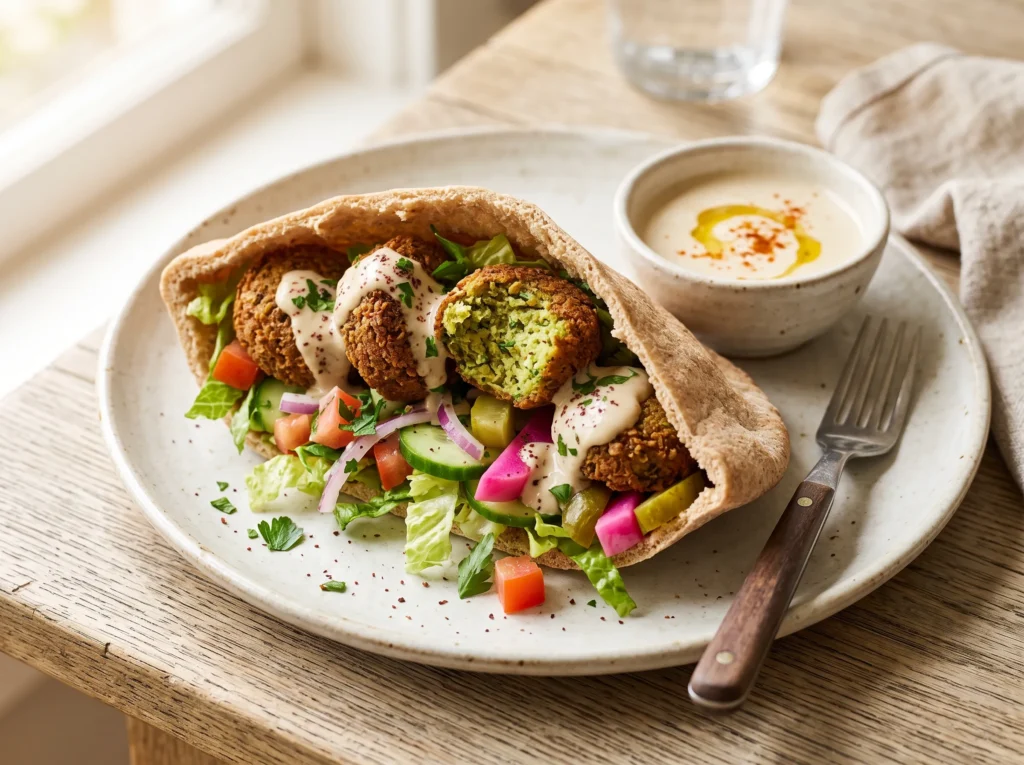
How to serve falafel in pita
Warm the pita briefly so it becomes soft and flexible.
Fill it with three or four falafel pieces, shredded lettuce, cucumber, tomato, red onion, and tahini sauce.
Pickled vegetables add a sharp, crunchy contrast to the creamy sauce and crispy falafel.
Serve falafel as a bowl
For a hearty meal, place warm falafel over hummus or rice.
Add chopped cucumber, tomato, lettuce, pickled vegetables, fresh herbs, and tahini sauce.
A squeeze of lemon brings all the flavors together.
Serve falafel as an appetizer
Arrange warm falafel on a platter with small bowls of tahini sauce, hummus, and garlic yogurt sauce.
Add cucumber slices, tomatoes, olives, and pickled vegetables around the platter.
This makes a colorful spread that works well for family meals and casual gatherings.
Add falafel to salads
Crispy falafel can turn a simple salad into a filling meal.
Combine lettuce, cucumber, tomato, red onion, parsley, and warm falafel, then drizzle with lemony tahini dressing.
The creamy dressing pairs especially well with the crunchy falafel.
Frequently Asked Questions
Can canned chickpeas be used for falafel?
Canned chickpeas are not recommended for this recipe.
They are already cooked and contain more moisture than soaked dried chickpeas. This can create a softer mixture that is more likely to fall apart during frying.
Why does falafel fall apart while frying?
The mixture may contain too much moisture, or the chickpeas may have been processed too finely.
Chilling the mixture, keeping the texture coarse, and adding a small amount of flour can improve its ability to hold together.
How long should chickpeas soak for falafel?
Dried chickpeas generally need about 12 to 18 hours of soaking.
They should become noticeably larger and hydrated but should not be cooked or soft like canned chickpeas.
Should baking soda be added to falafel?
A small amount of baking soda can help create a lighter interior.
It should be used sparingly because too much can affect the flavor and texture.
Why is homemade falafel not crispy?
Oil temperature is often the main reason.
Oil that is too cool allows the falafel to absorb more oil instead of quickly forming a crisp exterior. Overcrowding the pan can cause the same problem.
Can falafel be made without flour?
Yes, but the mixture must have enough natural structure to hold together.
If the chickpeas are processed correctly and the mixture is well chilled, flour may not always be necessary. However, a small amount provides extra insurance for beginners.
What oil is best for frying falafel?
Neutral oils with a suitable frying temperature work well.
Sunflower, canola, and vegetable oil are practical choices because they have mild flavors and work well for frying.
Can falafel be made without cilantro?
Yes.
Replace the cilantro with additional fresh parsley. The flavor will be slightly different but still fresh and delicious.
What sauce goes best with falafel?
Tahini sauce is one of the best choices.
Its creamy, nutty flavor balances the crispy chickpeas and fresh herbs. Garlic yogurt sauce and hummus are also excellent options.
How can falafel stay crispy after frying?
Drain the cooked falafel on a wire rack instead of stacking them on paper towels.
For serving later, reheat them in an oven or air fryer rather than the microwave.
Conclusion
Homemade Crispy Falafel is a simple, flavorful recipe that brings crunchy edges, a tender center, fresh herbs, and warm spices together in every bite.
The key is starting with soaked dried chickpeas, keeping the mixture coarse, chilling it before shaping, and frying the falafel at the right temperature.
Serve the golden pieces tucked into warm pita with tahini, hummus, crunchy vegetables, and pickled toppings, or turn them into a hearty falafel bowl or fresh salad.
Once the basic method is mastered, the recipe is easy to customize with extra herbs, spices, or a little heat. It is a delicious option for lunch, dinner, meal prep, or a satisfying snack.
For a crispy, fresh, and comforting homemade meal, Homemade Crispy Falafel is well worth making from scratch. Prepare a batch, add plenty of creamy tahini, and enjoy every golden bite.