Cottage Cheese Pancakes (3 Ingredients)
A carton of cottage cheese sitting in the fridge doesn’t always feel exciting, but blended into a batter with eggs and oats, it turns into one of the easiest high-protein breakfasts you can make. These 3 ingredient cottage cheese pancakes come together in a blender, cook up golden and fluffy, and taste nothing like cottage cheese once they hit the pan. No flour, no pancake mix, no hidden steps.
Table of Contents
- Why These Pancakes Work
- What You’ll Need
- How to Make Cottage Cheese Pancakes
- Tips for Fluffy, Non-Soggy Pancakes
- Flavor Variations
- What to Serve With Them
- Storing and Reheating
- Conclusion
- FAQ
Why These Pancakes Work
Traditional pancakes rely on flour and baking powder for structure. This version skips both. Cottage cheese adds moisture and protein, eggs bind everything together, and oats give the batter enough body to hold its shape on the griddle.
The result is a pancake that’s naturally higher in protein than a flour-based version, with a soft, slightly custardy center and lightly crisp edges. Because the batter has no added sugar or leavening agents, the pancakes taste mild rather than sweet, which makes them easy to dress up however you like.
What You’ll Need
The full recipe uses just three core ingredients, plus a pinch of salt and a little oil or butter for the pan:
- Cottage cheese – full-fat or low-fat both work; full-fat gives a slightly richer texture
- Eggs – act as the binder, so they can’t be left out or swapped
- Rolled oats – old-fashioned oats blend more smoothly than steel-cut oats
A blender is what makes this recipe realistic on a weekday morning. Combining the ingredients by hand tends to leave curds of cottage cheese visible in the batter, while blending breaks everything down into a smooth mixture that cooks evenly.
How to Make Cottage Cheese Pancakes
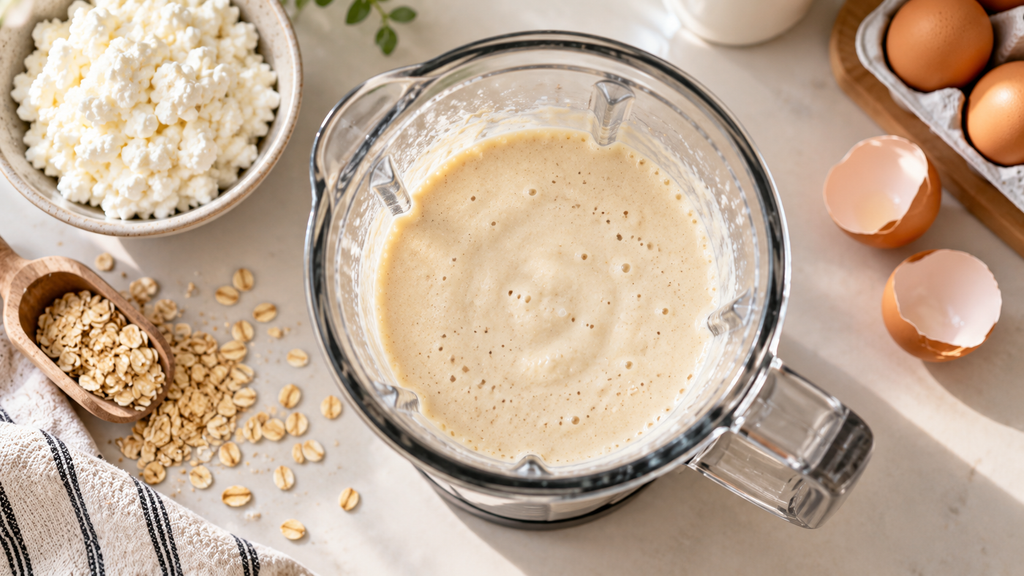
Blend the batter
- Blend the batter. Add the cottage cheese, eggs, and oats to a blender. Blend on high for 20 to 30 seconds, until the mixture is smooth with no visible oat pieces or curds.
- Rest the batter briefly. Let it sit for 1 to 2 minutes. This gives the oats a moment to soften slightly, which helps the pancakes hold together while cooking.
- Heat the pan. Warm a nonstick skillet or griddle over medium-low heat and add a small amount of oil or butter.
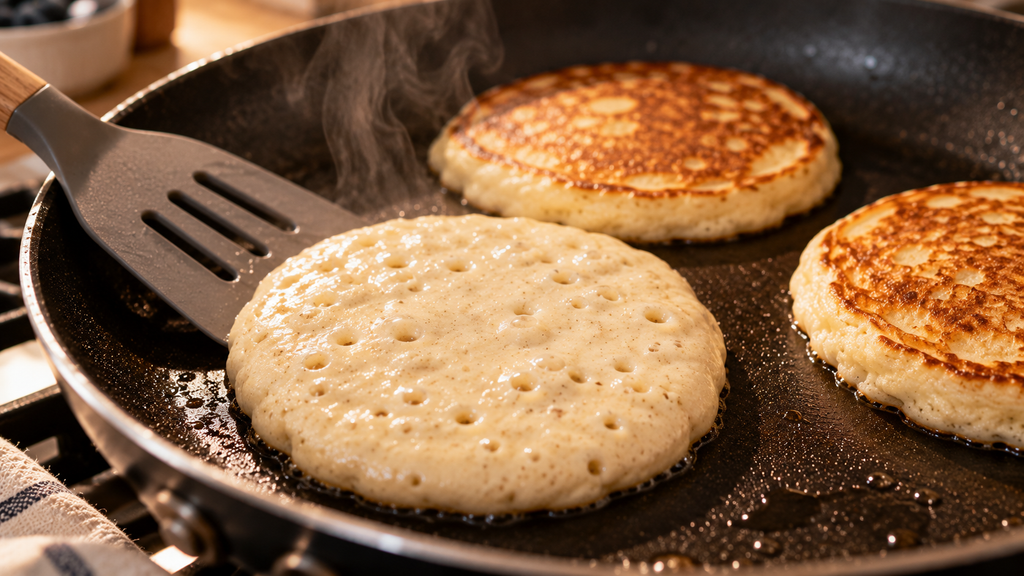
- Cook the pancakes. Pour about ¼ cup of batter per pancake onto the pan. Cover with a lid and cook for 2 to 3 minutes, until small bubbles form on the surface and the edges look set.
- Flip carefully. Use a thin, flat spatula to flip. Cook for another 2 minutes on the second side, until golden brown.
- Serve warm. Transfer to a plate and repeat with the remaining batter.
This makes roughly 8 to 10 medium pancakes, depending on size, enough for two servings.
Tips for Fluffy, Non-Soggy Pancakes
- Keep the heat moderate. High heat browns the outside before the inside sets, leaving the center undercooked. Medium-low heat gives the pancake time to cook through.
- Cover the pan while cooking. Because there’s no flour to help trap steam, a lid helps the center cook evenly without needing to flip too early.
- Don’t skip the blender rest. A minute or two of resting time noticeably improves texture, especially if using old-fashioned rather than quick oats.
- Use a nonstick surface. Without gluten to help the pancake hold its shape, a well-seasoned nonstick pan makes flipping far easier than a standard skillet.
Flavor Variations
Because the base batter is mild, it takes well to both sweet and savory add-ins.
Sweet directions:
- A teaspoon of cinnamon or vanilla extract blended into the batter
- Fresh blueberries or diced banana folded in just before cooking
- A drizzle of maple syrup or honey on top
Savory directions:
- A pinch of black pepper and chopped chives blended in
- Serve topped with a fried egg and hot sauce instead of syrup
- A sprinkle of grated parmesan on top while the pancake finishes cooking
Since the recipe has no added sugar to begin with, these directions don’t fight each other — the same base batter works for a sweet weekday breakfast or a savory brunch plate.
What to Serve With Them
A stack of these pancakes pairs naturally with:
- Fresh berries and a spoonful of Greek yogurt
- A light drizzle of maple syrup
- Sliced banana and a scoop of nut butter
- Scrambled eggs and avocado, for a fully savory plate
Because the pancakes are already protein-forward, they don’t need much added on top to make a balanced breakfast.
Storing and Reheating
Leftover pancakes keep well, which makes this a good recipe to batch on the weekend.
- Refrigerator: Store in an airtight container for up to 3 days.
- Freezer: Layer pancakes between sheets of parchment paper and freeze in a sealed bag or container for up to 2 months.
- Reheating: Warm in a toaster or toaster oven for a few minutes, or microwave for 20 to 30 seconds. Reheating in a toaster helps the edges stay slightly crisp instead of turning soft.
Conclusion
Cottage cheese pancakes prove that a short ingredient list doesn’t have to mean a boring breakfast. With just cottage cheese, eggs, and oats, you get a pancake that’s higher in protein than the traditional version, easy to flavor in either a sweet or savory direction, and simple enough to make on a weekday without pulling out measuring cups for flour or leavening agents. Once the batter’s blended, the rest is just a matter of patience with the heat.
FAQ
Can I make these pancakes without a blender? It’s possible with a whisk and some extra effort, but the texture won’t be as smooth. Cottage cheese curds tend to stay visible without blending, which affects the finished texture more than the flavor.
Can I substitute the eggs? Not easily. Eggs are what holds the pancake together since there’s no flour or baking powder in the batter, so a substitute would need strong binding properties, like a flax egg, though the texture will change.
Why are my pancakes falling apart when I flip them? This usually means the pan is too hot or the first side hasn’t cooked long enough. Give the pancake extra time on medium-low heat before attempting to flip.
Can I use a different type of oats? Old-fashioned rolled oats blend most smoothly. Quick oats can work in a pinch, but steel-cut oats generally don’t break down enough in a standard blender.
Are these pancakes gluten-free? Yes, as long as the oats used are labeled gluten-free, since standard oats are sometimes processed in facilities that also handle wheat.
Can I double the recipe? Yes. The recipe scales easily — just blend in the same ratio and cook in batches, keeping cooked pancakes warm in a low oven while the rest finish.